Focus Fuels Growth

Growth doesn't result from attempting everything; it results from consistently doing the right things.
Businesses that succeed are generally very firm on several key points: giving good service to customers, improving their skills, looking after their employees, and keeping aside the time necessary to carry out all of these. They too have problems, but they won't let low-value ones take up the day.
It is there that focus turns into a competitive advantage.
For most small businesses, the greatest threat to their ability to concentrate is not competition or a tough market but administrative drag. This includes manual timesheets, having to make payroll corrections, constantly rearranging schedules, failing to keep attendance records, and the time spent hunting for information that should already be available.
Once you have removed all that noise, your focus comes back, and focus is what leads to growth.
Focus Is a Business System
Focus is generally regarded as a personal ability, and we advise owners and managers to prioritize, plan more effectively, and avoid distractions.
The advice is useful, but it doesn't cover all the points.
The way your systems are set up shows how much focus your team is actually giving to its work; if your employees have to recall what they did on Tuesday last week, spend time writing it down on paper, or send a text to a manager to change a shift, then your business is making people use their energy on administrative tasks rather than on productive work.
The energy can be retrieved through a simple process.
Start by identifying the three areas that deserve your best attention:
Your customers: What does your customer need to have a better experience or for a real problem to be solved?
Your craft: What aspect of your craft enhances quality, speed, or profitability?
Your people: What aids your team in carrying out reliable work without causing unnecessary frustration?
All the other things should be subjected to scrutiny. Of course, that doesn't imply that all tasks are unimportant. What it does mean is that each task should justify its position on the calendar.
As we explored in Service Builds Business, excellent service is not just a customer-facing idea. It also means building internal processes that respect your team’s time.
Administrative Drag Steals More Than Time
Manual administration is so easy to underestimate that it comes in small portions.
Here's a missing timesheet, and there's a payroll correction as well. Ten minutes are spent checking where an employee began the day, thirty minutes are spent transferring the data from paper to a spreadsheet, and one afternoon is spent comparing the schedule changes with the attendance records.
No one finds these tasks to be a crisis; taken together, they form a second job.
Manual timesheets create several common problems:
Employees fail to record their hours or enter them from memory.
Managers take time to check entries, correct them, and approve them.
Payroll is then treated as a reconstruction project rather than being subjected to a review.
While work is taking place, the owners are hiding the cost of their labor.
Wrong records lead to disagreements and decrease trust.
Estimates for the job and future schedules are based on guesses rather than actual data.
An industry analysis carried out recently and based on HR research from 2026 has found that manual time tracking can lead to higher labor costs due to inaccuracies and the administrative burden involved. The precise effect will vary from one business to another, but the fundamental problem remains the same: small errors recur every pay period.
Which is why administrative delay is so hazardous since it builds up slowly.
A company will not notice a single mistake regarding the start time. Still, if you take a few minutes and multiply them across a team, throughout a workweek, and over an entire year, the result is actual money and lost attention.
The message of Every Minute Matters is straightforward: time is not an unlimited resource; it is the fuel your business uses to serve customers, solve problems, and produce something better.

Replace Memory With Reliable Information
A focused business does not rely on memory for important information.
That includes:
When an employee started and ended a shift
Where work took place
How much time a job required
Whether overtime was approved
Which projects are using more labor than expected
How many people are available for upcoming work
That's exactly where good time tracking software comes into its own. Instead of keeping an eye on every single second of the workday, the aim is to record accurate information when it is important, so that people won't have to reconstruct it later.
A mobile app for tracking employee time enables workers to record their arrival and departure, whether they are in the field, in the office, or at the job site. When employees are working remotely or across multiple locations, GPS verification can provide useful location information. Because the records are available in real time, managers can gain a better understanding of the situation without making frequent calls or checking in on people.
Technology should not lead to more micromanagement when used responsibly.
Make it clear from the start when location data is collected, who has access to it, and how it will be used. Being transparent helps build trust; the ideal system is one your team understands and can use without difficulty.
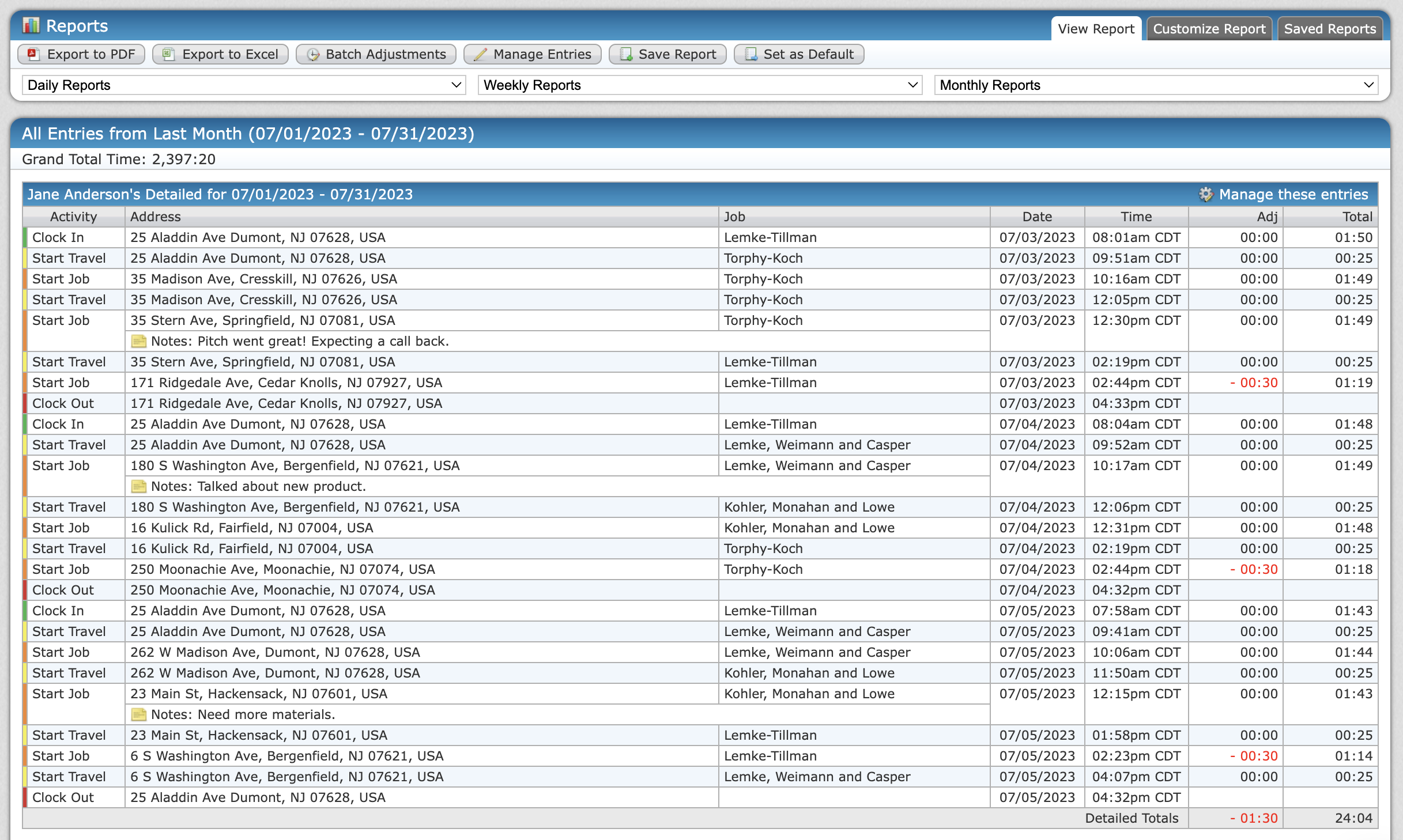
Labor Sync enables businesses to collect time and job-site information in real time and convert it into reports. Employees can use the app on their mobile devices, and the availability of multiple languages helps teams record their time accurately in their preferred language.
Turn Time Data Into Better Decisions
It is useful to keep accurate time records for paying workers, and their value increases when those records are used to improve the business.
A dependable timesheet software system will enable you to compare the planned labor with the actual llabor thus providing better answers to important questions:
What jobs are running longer than had been expected?
Are certain tasks consistently crIsn't it necessary to have more people at certain times? specific periods?
Are your estimates realistic?
Which work is profitable?
What is the source of the overtime costs?
Is the schedule effective or is it causing avoidable downtime?
What we're aiming for isn't merely to gather data for its own sake; it's to make our decisions earlier.
For instance, if a job is using more labor than planned, you can look into the situation while the work is still underway. It could be that the scope has changed. The materials might have arrived late. The crew may need better instructions. Or the estimate might have been incorrect.
You might not become aware of the problem until the payroll has been completed, or until the job is finished and the margin has disappeared.
As the article 'Data Beats Assumptions' states, clear information enables you to substitute guesswork with action.
Make Scheduling Simpler, Not Busier
Scheduling is also a frequent cause of noise.
If schedule changes are communicated via text messages, calls, sticky notes, and spreadsheets, no one will have a full understanding of what has happened. Employees might go to the wrong place. Managers might book a person too many times. Customers might get vague updates. As a result, everyone ends up spending the day making corrections rather than carrying out the schedule.
Whether you use specialized employee scheduling software or adopt a more basic shared process, make sure you have a single dependable source of truth.
A practical scheduling process should include:
Keep a schedule: A current schedule makes it clear to employees where to find updates.
Clear job details: Give clear details of the job: state the location, the expected start time, the role, and any special instructions.
A defined change process: Explain who is authorized to make a change and how employees are informed.
A connection to attendance: Link attendance to scheduled work by comparing scheduled work with actual clock-ins to identify any gaps.
A weekly review: Week by week, look for issues that recur before they turn into the usual.
A good scheduling system should avoid raising questions rather than creating more; if it takes employees five messages to understand a single shift, the system needs to be simplified.
The same idea is explained in Friction Is a Signal: since repeated confusion is useful information, it shows you that a process requires your attention.
Use Focus to Strengthen Your People
It's not just about being productive; it also positively affects the employee experience.
People perform better when expectations are clear, their time is respected, and when they are paid in accordance with the number of hours they have worked. Using a simple time clock app eliminates uncertainty about attendance and hours worked. Employees can record their time, check their records, and ask questions while the details are still fresh.
This is important for remote employees, field teams, and multilingual workforces; employees should not have to worry about their handwritten entries being misplaced or about managers misinterpreting a correction.
The best tools help to ensure accountability without compromising dignity by making the correct action simple:
Clock in from the correct location
Select the right job
Record breaks consistently
Review hours before payroll
Communicate corrections through a clear process
The more time your team can spend not struggling against the system, the more energy they will have for the customers and for the work itself; that is a practical way of putting People First, Business Follows.
A Simple Focus Audit for Your Business
It's not necessary to make all the changes at once,e so begin with a week-long period of observation.
Ask these questions:
What caused the team to lose time?
Make a list of all the administrative tasks that disrupt productive work, including payroll questions, schedule changes, missing approvals, and the need to enter data twice.
What are the tasks that depend on memory?
If anyone must recall where they were, what they had been working on, or when their shift began, then that procedure should be identified as one needing improvement.
Where do errors repeat?
Check whether the same payroll corrections, attendance disagreements, or scheduling errors are occurring more than once; repeated errors are generally due to problems with the process rather than to individual employees.
What kind of information would enable you to take action sooner?
You might need the labor figures broken down by job, real-time attendance tracking, or simply a better view of who is working and where.
What aspects are capable of being automated or made simpler?
Select a single process and cut the number of steps in it. A little improvement made each week is more worthwhile than a difficult one that goes unutilized.
As the message in Small Steps Compound makes clear, consistent effort turns small changes into real progress.

Clear the Noise and Keep Moving
Focus fuels growth because focused businesses make better use of their li. They spend more time attending to customers and less time hunting down information. Rather than correcting mistakes that could have been avoided, they work to improve their skills. They provide their staff with clear expectations and reliable systems. Reliable systems.
You won't need additional meetings, more spreadsheets, or more reminders to achieve focus. What you need is to eliminate the unnecessary steps.
If manual timesheets, payroll issues, attendance questions, or the constant need to rearrange schedules are taking time away from the business, you should begin by improving the process that causes the most trouble. A time-tracking software solution can help automate time capture, GPS verification, and reporting, so your team ends up with better information while putting in less effort.
Labor Sync is a practical solution for that type of task; it provides small businesses with real-time tracking of their employees' time, visibility into job sites, customizable reports, and mobile access all without the need for additional time clocks or complicated equipment.
Growth is built through repeated, focused effort. Protect that effort, and your business has room to move.