Simple Scales

There’s a common myth in the business world that growth is supposed to be loud, heavy, and incredibly complicated. We’ve been conditioned to believe that as a company gets bigger, the "manual" for how to run it should eventually look like a CVS receipt, endless, confusing, and full of things nobody actually asked for.
But here’s the cold, hard truth: complexity is where growth goes to die.
When you’re a small team of three people working out of a garage (or a single truck), you can handle a little chaos. You can track hours on a napkin, shout instructions across the site, and keep your "accounting" in your head. But the moment you add a fourth, fifth, or tenth person, those napkins start to disappear. The shouting gets drowned out. And suddenly, the "simple" way you used to do things feels like you’re trying to build a skyscraper on a foundation of Jell-O.
If you want to grow without losing your mind, you have to embrace a new mantra: Simple scales.
The Complexity Trap: Why More Isn’t Always Better
Most business owners react to growth by adding "stuff."
We have a communication problem? Add a new messaging app.
Payroll is taking too long? Add a 15-page manual on how to fill out the 10-page timesheet.
Projects are falling behind? Add a weekly three-hour "sync" meeting to talk about why we’re behind.
Before you know it, you’ve built a "Frankenstein" system. It’s alive, sure, but it’s clumsy, it’s scary to look at, and it takes a massive amount of energy just to keep it from falling apart. This is what we call the Complexity Trap.
The problem with complex systems is that they are impossible to repeat. If it takes six months of training for a new hire to understand how to report their hours, you aren’t scaling; you’re just creating a bottleneck. Growth comes from removing friction, not adding more gears to the machine.
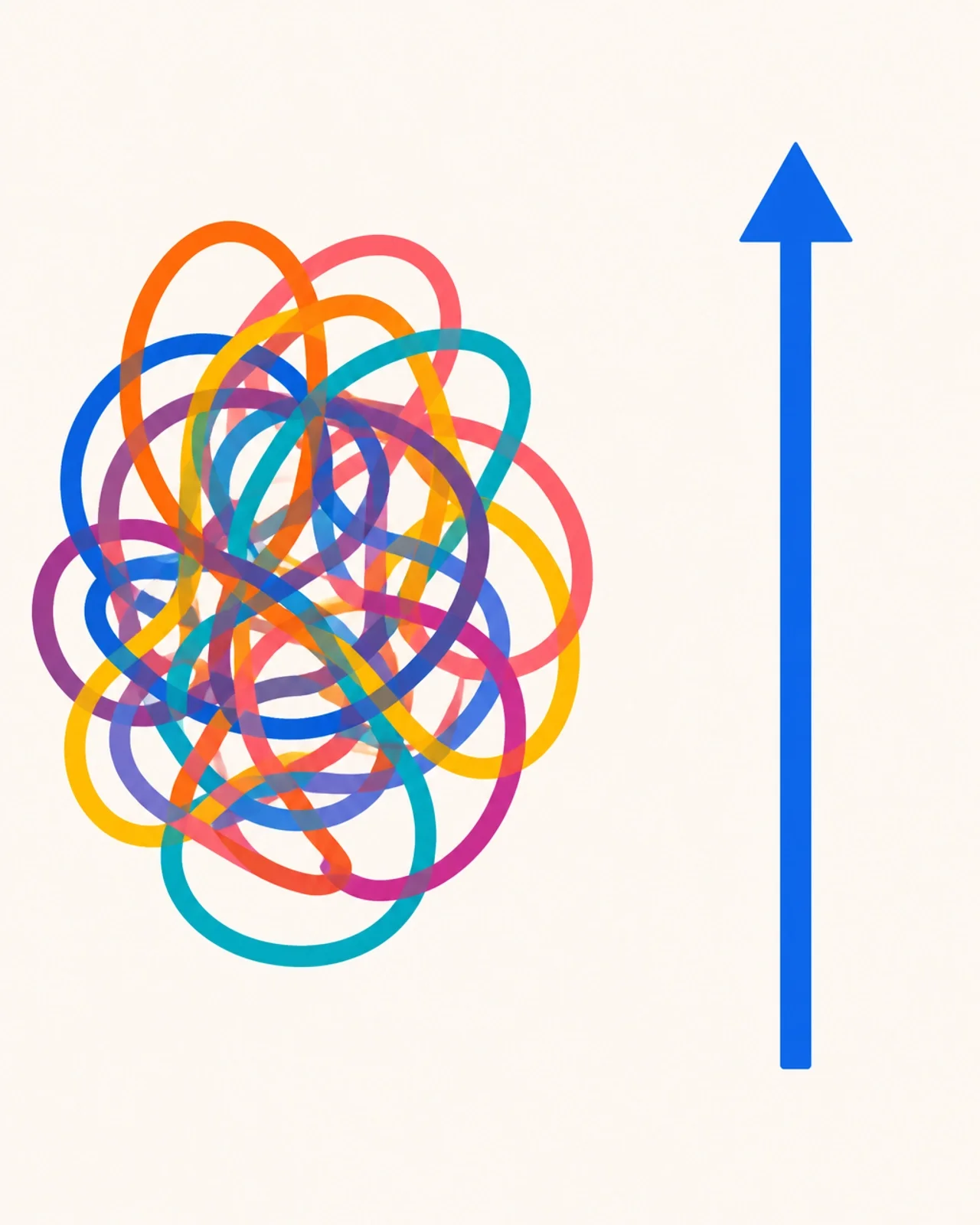
If a Fifth-Grader Can’t Do It, Your Business Won’t Scale
Think about the most successful franchises in the world. Whether you like their burgers or not, McDonald’s is a masterclass in simplicity. A teenager can walk into a kitchen in Tokyo, London, or Des Moines and know exactly how to make a fry. Why? Because the system is so simple it’s almost impossible to get wrong.
Your business needs that same "fry-cook" level of simplicity.
When your processes are simple, they become repeatable. And when they are repeatable, they become predictable.
Take your field crew, for example. These guys are out in the sun, in the rain, and under pressure. The last thing they want to do at the end of a 10-hour shift is navigate a complex software suite or hunt for a pen that actually works to fill out a paper log. If your time-tracking system has more than two steps, you’re going to end up with untracked time and lost profit.
The "Simple Scales" Framework: Standardize, then Simplify
How do you actually strip away the junk and get back to basics? It starts with a simple three-step framework.
1. Standardize the Basics
You can’t simplify what you haven’t defined. If Joe tracks his hours on his phone, Mike uses a notebook, and Sarah just "remembers" them at the end of the week, you don’t have a system, you have a headache. Pick one way to do things. Just one.
2. Kill the "Exceptions"
"Well, we usually do it this way, unless it’s a Tuesday and the client is Bob." Stop it. Exceptions are the cracks where profit leaks out. Every time you create a "special" rule for a specific situation, you’re adding a weight that your team has to carry. A solid foundation fixes problems later, but that foundation has to be level.
3. Automate the Boring Stuff
Once you have a standard, simple process, get it off your plate. This is where people get confused. They think software will fix their chaos. It won't. Software doesn’t fix chaos, it exposes it. You have to simplify the process before you put it into an app. Once it’s simple, the app makes it effortless.
Real-World Simplicity: The Timesheet Test
Let’s look at the most common growth-killer: payroll and time tracking.
For many small businesses, payroll day is a day of mourning. It involves chasing down paper sheets, squinting at bad handwriting, and trying to figure out why someone was "on-site" for 14 hours but only did 4 hours of work.
A "complex" solution would be hiring a full-time "Payroll Chaser" or buying an enterprise-level HR suite that costs more than your trucks.
A "simple" solution? An app with a big green button that says "Start" and a big red button that says "Stop."
By giving your team a tool that is easier to use than a paper sheet, you remove the friction. They use it because it’s easy. You get the data because it’s automatic. Suddenly, payroll takes ten minutes instead of ten hours. That’s scaling.

Guarding Against "Complexity Creep"
As you grow, complexity will try to sneak back in. It’s like weeds in a garden. You’ll be tempted to add "just one more feature" to your workflow or "just one more step" to your customer onboarding.
When that happens, ask yourself: "Will this make the job easier for the person actually doing the work?"
If the answer is no, don't do it. If you’re adding a step just so you feel more in control, you’re actually moving toward growth without control. True control comes from having a system that works even when you aren't looking.

The ROI of Doing Less
At the end of the day, simplicity isn't just about making life easier: it's about making your business more valuable. A business that relies on a complex web of "tribal knowledge" and manual work is a business that is hard to sell, hard to manage, and hard to grow.
A business that runs on simple, repeatable systems is an asset. It’s a machine that you can pour more leads into and get more profit out of without it exploding.
So, take a look at your operations this week. Where is the "messy knot"? Where are you doing things the "hard way" because "that’s how we’ve always done it"?
Cut the cord. Simplify the step. Scale the business.
Wrapping Up
Growing a business is hard enough. Don't make it harder by building a labyrinth your employees can't navigate. Remember: if it's simple, it's scalable. If it's complex, it's a cage. Choose simplicity every single time.