Busy Does Not Equal Effective
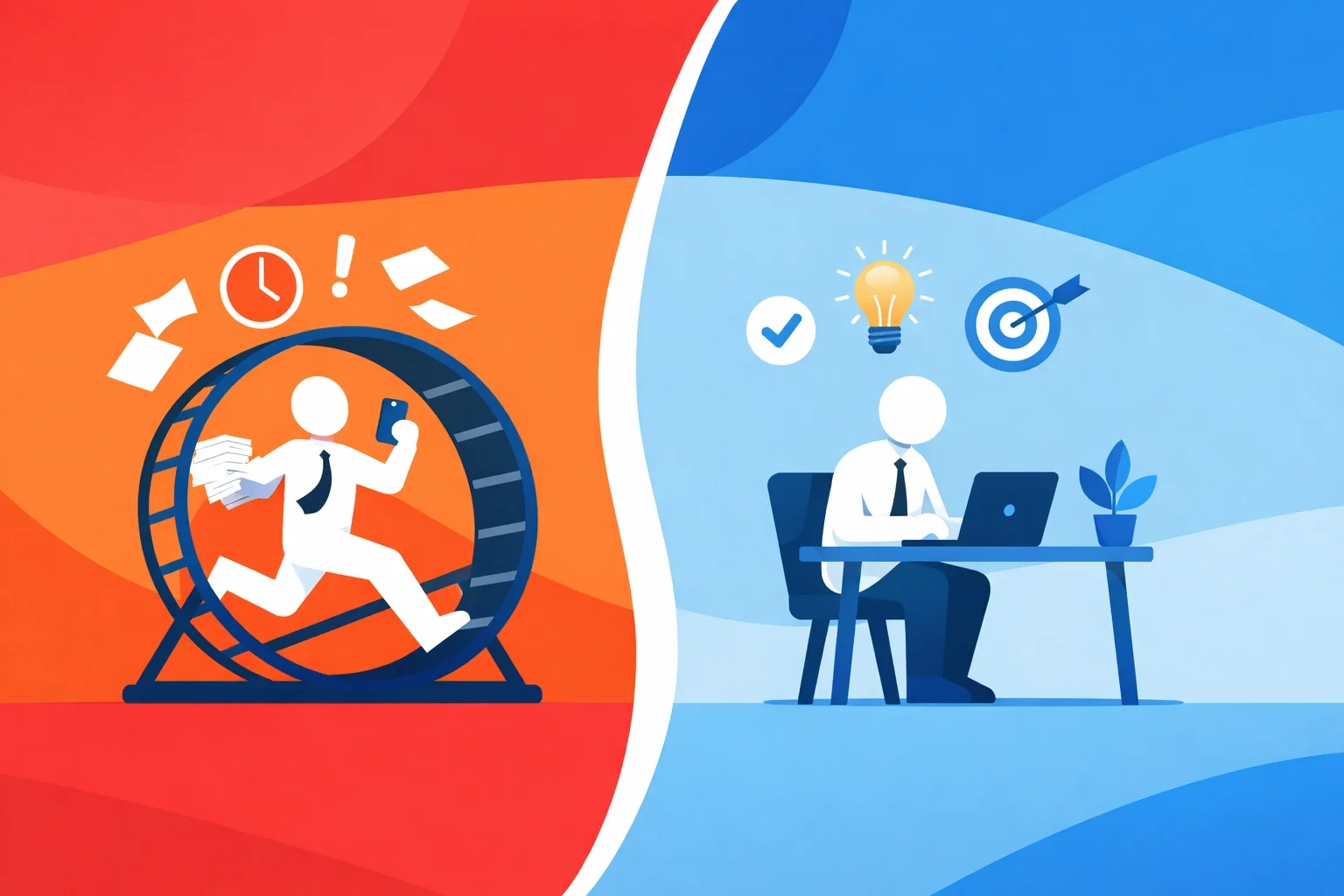
You’re exhausted. You’ve been at it since 6:00 AM. Your phone has rung forty times, you’ve dealt with a late concrete delivery, and you’ve spent the last hour trying to decipher a timesheet that looks like it was written in a hurricane.
You feel like a hero. You’re "hustling." You’re "grinding."
But let’s be honest: your bank account doesn’t care how tired you are. Your business doesn't grow based on how many fires you put out; it grows based on how many you prevent.
In the construction and field service world, we’ve glorified being "busy." We wear it like a badge of honor. But busy is often just a polite word for distracted. If you’re spending your day chasing data instead of using it, you aren’t being effective. You’re just moving fast in a circle.
The Trap of "Fake Work"
"Fake work" is the stuff that fills your day but doesn't move the needle. It feels like work because it’s stressful and time-consuming, but it’s actually a symptom of a broken system.
Consider these common "busy" tasks:
Calling three different foremen to find out if the crew actually showed up at the Smith job.
Manually entering hours from coffee-stained paper scraps into a spreadsheet.
Driving to a job site just to see if a piece of equipment is still there.
Correcting payroll errors because someone "forgot" they took a long lunch on Tuesday.
This isn't management. It’s babysitting. According to hidden productivity killers, these small interruptions and manual tasks are the silent assassins of your profit margins.

The 23-Minute Rule
Here is a fun fact that will make you want to throw your clipboard into a woodchipper: Research shows that after a single interruption, it takes an average of 23 minutes to regain full focus.
Think about that. Every time your phone vibrates with a "where are you?" text or a "how many hours did I work?" call, you aren't just losing the two minutes of the conversation. You’re losing nearly a half-hour of high-level brainpower.
When you operate in a state of constant interruption, you are stuck in "shallow work." You can't think about scaling. You can't analyze your field ops efficiency. You’re just a human switchboard.
Busy vs. Effective: The Breakdown
Let’s look at the difference in real-world terms.
Busy Management:
Reactionary: You wait for a problem to happen, then scramble to fix it.
Data-Starved: You make decisions based on "gut feelings" because your actual data is buried in a pile of paper on the dashboard.
Multitasking: You’re doing five things at once and finishing none of them well.
The Goal: Just getting through the day.
Effective Management:
Proactive: You see potential issues in real-time and steer around them.
Data-Driven: You know your exact labor costs per project as they happen.
Deep Focus: You delegate the "busy work" to systems so you can focus on winning the next big contract.
The Goal: Increasing margins and maximizing mobile workforce productivity.
Effective managers don't work harder; they work on the right things. They realize that their time is worth $200 an hour, yet they often spend it doing $15-an-hour administrative tasks.
Why Your Office is a Paper Graveyard
Paper timesheets are the ultimate "busy" trap. They create a loop of useless activity.
The employee has to remember their hours (usually on Friday afternoon).
The manager has to collect the paper.
The admin has to read the handwriting.
The owner has to approve the "guesstimates."
This is a massive waste of energy. It’s also a breeding ground for "time theft", those extra 15 minutes added here and there that quietly bleed your company dry. Switching from blueprints to smartphones isn't just about being tech-savvy; it’s about eliminating the friction that keeps you busy but broke.
Turning Chaos into Insight
If you want to move from busy to effective, you need a single source of truth. You need to stop asking "Where are we at?" and start seeing it.
This is where Labor Sync comes in. We didn't build a "tracking app" just to watch people. We built it to kill the "busy work."
Imagine a Monday morning where:
You don't call anyone to check attendance. You see the GPS pings on your screen.
You don't guess labor costs. You see the real-time budget burn.
You don't hunt for signatures. They’re already digitized and filed.
When the manual chaos is automated, you suddenly have "white space" in your calendar. You can finally look at safety-productivity balance or plan for 2026 labor law changes. That is effectiveness.

The Mental Health of the Jobsite
It’s not just you. Your crew hates the "busy" trap too. Nobody likes being micromanaged or asked the same question three times. When communication is messy, stress levels rise.
Effective systems build trust. When employees know their hours are tracked accurately and their paychecks will be correct, they focus on the work. High-trust environments are inherently more productive. We talk about this extensively in our post on trust and productivity in a mobile workforce.
A clear system reduces the mental load on everyone. It allows your foremen to be leaders instead of data entry clerks.
How to Audit Your Day
If you aren't sure if you're busy or effective, try this for 24 hours: Write down every task you do. At the end of the day, ask yourself: "Could a software program or a $20/hour assistant have done this?"
If the answer is "yes" for more than 50% of your list, you aren't an effective business owner. You’re an overqualified admin.
Effective work looks like:
Reviewing project profitability.
Building relationships with high-value clients.
Implementing lean construction on the go principles.
Training your team to handle more responsibility.
The Bottom Line
The "hustle" is a lie if it doesn't lead to progress. If you’re running yourself into the ground just to keep the lights on, something has to change.
You don’t need more hours in the day. You need to stop wasting the ones you have on tasks that don’t matter. Get out of the truck, put down the paper timesheets, and start managing your business like it’s 2026, not 1996.
Labor Sync is the tool that moves you from the "busy" column to the "effective" column. It’s not just about tracking time; it’s about buying back yours.